- The Product Prism
- Posts
- 🔥💼 Managing the Flame: The Art of Product Lifecycle Management
🔥💼 Managing the Flame: The Art of Product Lifecycle Management
A comprehensive product lifecycle management Toolkit

Gloria Adebayo
November 07, 2024 • Estimated Reading Time: 12 minutes
In this issue
Managing a product throughout its lifecycle, from ideation to sunset, is a rare experience – one I've had but wouldn't want to experience again. Building a product from scratch and seeing it go through all the lifecycle stages can make sunsetting feel like a heart-wrenching breakup💔. I went through the motionssss 🎢 🥹.
As product managers, we never know what stage the next product we’ll manage will be at. Hence, there is a need to be familiar with managing every lifecycle stage.
In the last issue, we explored the Product Lifecycle, describing each stage from ideation to retirement; we discussed unique challenges and best practices for these phases.
This week, we're building on that foundation with Product Lifecycle Management (PLM) – the framework supporting every phase.
PLM optimizes the journey through strategic planning, cross-functional collaboration, and continuous improvement. It ensures products deliver value efficiently from conception to sunset.
In this issue, discover:
The activities and planning required for each phase.
Key metrics for tracking performance and optimizing resources.
Indicators of success for each phase.
PLM Tools & Technologies.
By the end, you'll have a comprehensive toolkit for navigating the product lifecycle with precision and control.
What is Product Lifecycle Management?
PLM is a strategic framework used to manage products from ideation to retirement efficiently and effectively. It ensures that every phase in the product lifecycle aligns with business goals, reduces waste, optimizes performance, and delivers value. PLM involves coordinating teams, managing timelines, tracking performance, and driving improvements across the product lifecycle.
Think of it as the operational engine behind the product lifecycle that ensures each stage flows seamlessly into the next, with data, processes, and decisions tightly aligned.
1. Ideation & Conceptualization 💡
Primary Focus: Validate the concept, define product vision & goals, and identify MVP features.
PLM in Action
Develop a product brief to align stakeholders on the vision and scope.
Use tools like Lean Canvas to frame the business opportunity.
Track all ideas and concepts through a centralized repository.
Near-Term Planning:
Outline the Go-to-Market (GTM) Strategy: Start mapping out a high-level GTM plan to prepare for product launch and gather early interest.
Identify Key Metrics: Determine early indicators of concept validation, such as user interest, feedback scores, or waitlist sign-ups.
Long-Term Thinking:
Scalability Considerations: Consider possible infrastructure, resource needs, or tech stack that might be required as the product grows, but keep options flexible.
Create a Roadmap Outline: Sketch out a broad product roadmap to guide initial development phases and support early discussions around future growth.

Product Lifecycle Phase 1: Activities & Planning
Indicators of Success:
Efficient validation with strong alignment on the product’s potential and vision.
Stakeholder buy-in on the concept and its roadmap.
Key Metrics
Metric | What? | How? |
|---|---|---|
Concept Validation Progress | Tracks the completion of key validation activities, such as user research, stakeholder alignment, or early testing. | Use a checklist or status tracker to monitor the completion of each validation step (e.g., concept testing, user feedback interviews). |
Initial User Interest or Demand | Gauges initial interest or demand to assess market potential. | Track sign-ups for a waitlist, early access requests, or interest surveys. e.g., measure the number of users signing up for updates or indicating interest in the product idea. |
User Problem-Solution Fit | Determines how well the product concept addresses a real user need. | Conduct user interviews or surveys and calculate the percentage of users who find the concept relevant or beneficial. This might include using scoring (e.g., % of users who rate the concept as highly valuable on a 5-point scale). |
2. Development & Validation 🛠️:
Primary Focus: Build and refine the MVP, Run validation tests, and Foster team alignment
PLM in Action
Coordinate cross-functional teams using agile frameworks to ensure timely delivery.
Implement version control to manage prototypes and iterative builds.
Monitor technical feasibility and address bottlenecks with real-time dashboards.
Near-Term Planning:
Launch Preparation: Begin drafting onboarding processes, initial documentation, and support materials to be ready for launch.
User Feedback Mechanisms: Set up methods to collect feedback directly from early adopters for ongoing improvement.
Long-Term Thinking:
Prepare for Growth Needs: Consider possible tech and operational needs that may come into play with increased usage, but avoid committing to specifics until launch validates the concept.
Feature Prioritization: Start an evolving list of features that could be prioritized post-launch based on initial user feedback and demand.
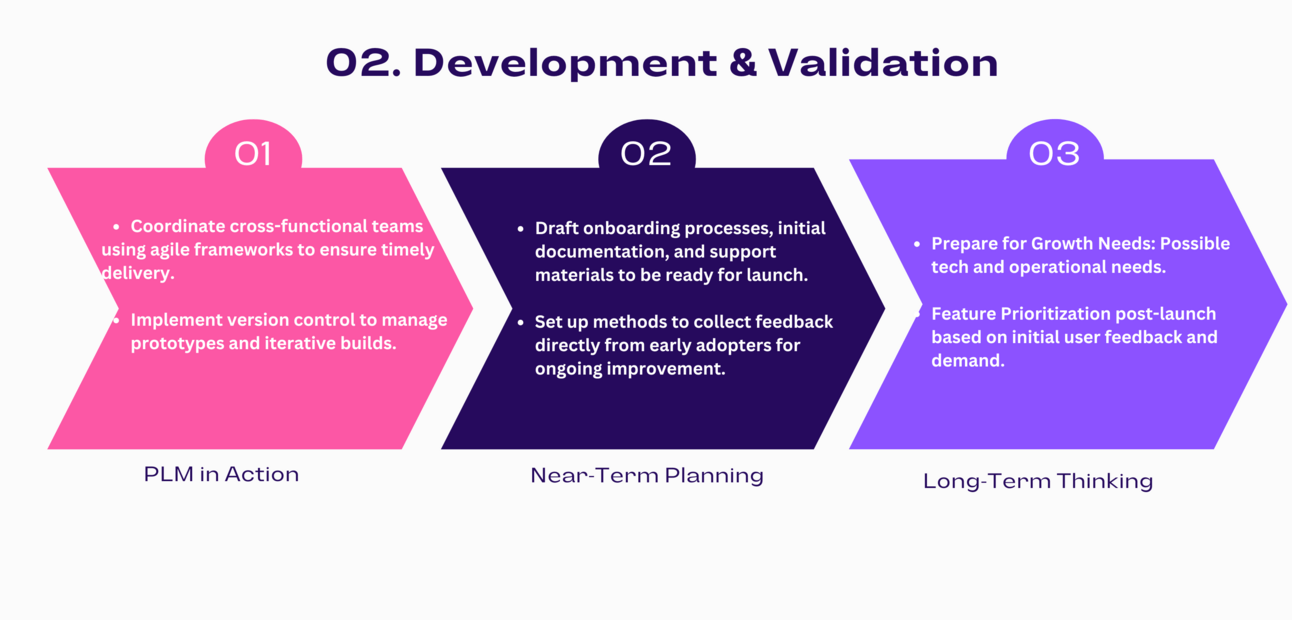
Product Lifecycle Phase 2: Activities & Planning.
Indicators of Success:
High development velocity with minimal bug issues.
Early feedback from testing shows alignment with the intended functionality.
Key Metrics
Metric | What? | How? |
|---|---|---|
Sprint Velocity | Measures work completed per sprint to assess development efficiency. | Track completed story points or tasks in each sprint. |
Bug Detection Rate: | The number of bugs found during validation, indicating product stability. | Divide total bugs found by features tested during validation to assess quality. |
3. Launch & Go-to-Market Strategy 🚀
Primary Focus: Drive initial traction, capture early user feedback, and set a baseline for key performance metrics.
PLM in Action
Align marketing, sales, and customer support teams through launch readiness checklists.
Track launch metrics such as customer acquisition and conversion rates.
Establish war rooms or rapid-response teams to address any post-launch issues.
Near-Term Planning: Develop a user onboarding process and feedback loop for continuous improvement.
Long-Term Thinking: Identify growth channels, such as partnerships, feature expansions, or new target audiences, to be prepared if early traction is strong.

Product Lifecycle Phase 3: Activities & Planning.
Indicators of Success:
A strong initial user base with high conversion rates and a manageable CAC.
Positive customer feedback on onboarding and early interactions.
Key Metrics
Metric | What? | How? |
|---|---|---|
Customer Acquisition Rate | The rate of new user sign-ups or purchases following launch. | Track acquisition sources (organic, paid, referral) to see which channels drive initial users. |
Customer Acquisition Cost (CAC) | The average cost to acquire each customer is essential for assessing launch efficiency. | Divide total marketing and sales costs by the number of new customers acquired in the same period. |
Conversion Rate: | The percentage of users who move from trial or free tiers to paid versions. | Divide paying users by total users (or trials) to assess conversion success. |
Customer Satisfaction Score (CSAT) | Early feedback from users on their initial experience | Use post-signup or onboarding surveys to capture CSAT scores. |
4. Growth & Scale 📈 📊
Primary Focus: Increase market share, optimize features, and build customer loyalty.
PLM in Action
Use performance monitoring tools to track feature usage and adoption.
Optimize the customer journey by integrating analytics with CRM systems.
Develop contingency plans for unexpected growth (e.g., server scaling, product support).
Near-Term Planning: Monitor signals for maturity, such as slowed growth rates or fewer feature requests, and build strategies for retaining customers.
Long-Term Thinking: Begin identifying costs and areas to streamline in the Maturity phase to improve profitability.

Product Lifecycle Phase 4: Activities & Planning
Indicators of Success:
Sustained or increasing MAU and high retention rates.
Consistent revenue growth is driven by customer engagement and satisfaction.
Key Metrics
Metric | What? | How? |
|---|---|---|
Monthly/Daily Active Users (DAU/MAU) | The number of unique active users each month/day | Use analytics platforms like Mixpanel, Amplitude or Pendo to track user engagement month-to-month. |
Engagement Rate | The frequency and depth of user interactions, such as time spent in-app, sessions per user, and feature usage. | Track key interaction points, such as daily active users (DAU) to MAU ratio, average session length, and feature adoption rates. |
Customer Retention Rate | The percentage of users who continue to use the product over a set period. | (Users at the end of the period - New users during the period) / Users at the start of the period. |
Revenue Growth Rate | Month-over-month or year-over-year growth in revenue, indicating successful expansion. | Calculate revenue growth as (Revenue in the current period - Revenue in the previous period) / Revenue in the previous period. |
5. Maturity & Optimization 🧰 :
Primary Focus: Retain users, manage costs, and extend product lifespan.
PLM in Action
Conduct periodic usability audits to keep the product competitive.
Use PLM tools to manage technical debt and decide what features to enhance or retire.
Implement pricing model reviews to optimize profitability and reduce churn.
Near-Term Planning: Conduct usability audits and optimize for core user needs. Evaluate which features can be sunsetted or streamlined.
Long-Term Thinking: Assess potential pivot options or product expansions that could extend product life. Consider initial criteria for a possible sunset plan.

Product Lifecycle Stage 5: Activities & Planning.
Indicators of Success:
High CLV with a low churn rate, indicating strong user loyalty.
Positive NPS scores, showing high user satisfaction and product stickiness.
Key Metrics
Metric | What? | How? |
|---|---|---|
Customer Lifetime Value (CLV) | The average revenue generated from each user over their lifetime. | (Average Revenue Per User x Customer Lifetime) - Cost of Acquisition. |
Net Promoter Score (NPS) | Measures customer loyalty by asking users how likely they are to recommend the product. | Use NPS surveys periodically to gauge user sentiment and track changes over time. |
Churn Rate | The rate at which customers leave the product over a given period. | (Users at start of period - Users at end of period) / Users at start of period. |
6. Decline & Product Retirement 🌆 :
Primary Focus: Retire the product gracefully and capture learnings for future projects.
PLM in Action
Use scenario planning to determine if the product should pivot, integrate into another offering, or be retired.
Develop a retirement plan that includes user communication, support, and migration paths.
Archive product data and conduct a post-mortem analysis to capture key lessons.
Near-Term Planning: Develop a sunset plan that includes customer communication, migration options, and final support plans.
Long-Term Thinking: Archive data and conduct a post-mortem analysis to capture insights for future product development cycles.

Product Lifecycle Stage 6: Activities & Planning.
Indicators of Success:
Low disruption for users and a smooth transition to alternative products.
Successful cost reduction with minimized impact on brand reputation.
Key Metrics
Metric | What? | How? |
|---|---|---|
Customer Migration Rate | The percentage of users who switch to alternative products offered by your business. | Track the number of users who successfully migrate vs. those who discontinue. |
Cost Savings from Retirement | Measure the reduction in operational costs as the product is phased out. | Compare operational costs before and after sunsetting the product. |
Key Elements of Agile PLM in Practice
Flexible Roadmaps:
Use roadmaps that focus on immediate goals, outline high-level plans for the next phase, and allow for adaptability based on real-time data.
Continuous Feedback Loops:
Customer feedback and analytics help detect when it’s time to shift stages. A strong feedback loop enables proactive planning, such as pivoting or adjusting priorities.
Collaboration and Communication:
Keep all teams aligned on near-term and next-phase goals. Regular cross-functional check-ins ensure everyone stays on the same page.
Tools and Technologies for PLM:
Project Management Tools:
These tools ensure efficient coordination across teams, tracking milestones and deliverables. Examples: Jira, Asana, Monday.com.
Analytics Platforms:
These provide insights into product performance, user behaviour, and key metrics across lifecycle stages. Examples: Tableau, Mixpanel, Amplitude, Pendo, Hotjar.
Testing Platforms
These tools help with various testing activities: A/B Testing, UI/UX Testing, Interviews, etc. Examples: Optimizely, UserTesting.com, HotJar
Conclusion:
Incorporating Product Lifecycle Management (PLM) into your processes ensures that your product stays on track, evolves effectively, and delivers value at every stage. PLM offers a structured approach to managing everything from product ideation to sunset, ensuring that decisions are made efficiently, teams are aligned, and resources are optimized for maximum impact.
Metrics provide product managers with clear indicators of success at each lifecycle phase. By focusing on current priorities, anticipating future needs, and measuring performance, product managers can navigate the product lifecycle with precision and adaptability—ensuring each stage is optimized for success.
Question & Answer 🙋♀️
Q: "How is PLM different from regular product management?"
A: PLM is a structured framework for managing the entire lifecycle of a product, from ideation to retirement, with a focus on processes, tools, and cross-functional collaboration. Product management, on the other hand, focuses more on strategic decision-making and product-market fit throughout that lifecycle.
Send me your questions by hitting reply!