- The Product Prism
- Posts
- 🎬 Mastering the Art of Storytelling: A Guide for Product Managers
🎬 Mastering the Art of Storytelling: A Guide for Product Managers
PM? Founder? You need this!

Gloria Adebayo
December 05, 2024 • Estimated Reading Time: 8 minutes
In this issue
If there’s one skill as a product manager that will set you apart from others, it is storytelling, which connects with your audience and executives the way no one else will. Every great product has a story, but are you telling it effectively? Storytelling is more than a soft skill—it’s a strategic tool that helps product managers align teams, persuade stakeholders, and connect with customers.
In this issue, you’ll learn:
Why you need to level up your storytelling skills. ⬆️
The core building blocks of storytelling. 🧱
Two powerful storytelling frameworks: The Hero’s Journey and Setup-Takeaway-Payoff. 🛫
Practical applications of storytelling. 🗣️
Tips for Effective Storytelling. 💡
Whether you’re pitching a vision, gaining stakeholder buy-in, or engaging users, mastering storytelling will help you transform ideas into impact.
My AI friends did a really good job discussing the topic this week. Take a listen below 👇
Let’s go! 🏎️
Storytelling in Product Management
Product managers are often the bridge between users, engineers, marketers, and executives. Communicating effectively across these groups requires more than raw data—it takes a story that connects on a logical and emotional level.
Why should you bother about storytelling?
Communication: Storytelling enables you to communicate complex ideas, data, and product visions in a clear, concise, and engaging manner.
Emotional connection: Stories create an emotional connection with your audience, whether it's customers, executives, or stakeholders. This connection helps build trust, empathy, and understanding.
Context and meaning: Storytelling provides context and meaning to data, features, and product decisions. It helps your audience understand the "why" behind your product's existence.
Influence and persuasion: Storytelling can be a powerful tool for influencing and persuading others. By crafting compelling narratives, you can inspire action, build support, and drive decision-making.
Differentiation: Effective storytelling can differentiate you from other product managers. It showcases your ability to think creatively, communicate complex ideas, and connect with your audience.
As a product manager, storytelling isn’t just a soft skill—it’s your superpower.
The Building Blocks of Effective Storytelling
Every great story has three core elements:
Characters: The heroes of your story—users, teams, or stakeholders. Identify who benefits from your product or decisions.
Conflict: The problem your product solves. A relatable problem keeps your audience engaged.
Resolution: The value or impact your product creates. Show how your product drives meaningful outcomes for users or the business.
Storytelling Frameworks
As a product manager or founder, you're constantly communicating with stakeholders, customers, and team members. Storytelling is an essential skill to convey your vision, ideas, and goals in a compelling and memorable way. To help you craft effective stories, we'll explore some storytelling frameworks and provide tips for incorporating them into your daily work.
There are many frameworks that you could use to fit a narrative.
Problem-Agitate-Solve (PAS)
FAB (Features-Advantages-Benefits)
Before-After-Bridge (BAB)
Hero’s Journey
Setup-Takeaway-PayOff
In this issue, we will focus on the last two above.
Framework 1: The Hero’s Journey
The Hero’s Journey positions the user as the hero and your product as the trusted guide that helps them succeed. This approach works best when crafting user-centric narratives like case studies or onboarding stories.
Call to Adventure:
The user faces a challenge or problem.Example: “Freelancers struggle to manage invoices, leading to late payments and financial stress.”
The Hero’s Transformation:
The user adopts your product to overcome the problem.Example: “Our automated invoicing feature reduces stress by simplifying invoice creation and payment tracking.”
Resolution and Growth:
The user achieves their goal and unlocks new opportunities.Example: “With streamlined invoicing, freelancers save time and get paid faster, allowing them to focus on growing their business.”
Pro Tip: Use this framework in product demos and marketing materials to make your product’s value feel personal and relatable.
Framework 2: Setup-Takeaway-Payoff
The Setup, Takeaway, and Payoff framework ensures clarity and impact in your stories. It’s ideal for presentations, pitches, and updates where time is limited, and you need to make an impression quickly.
Setup: Establish the context and challenge. The setup should gain the audience's interest and attention and make them look forward to hearing the takeaway. The setup includes setting, character, and conflict.
Example: “Our user research revealed that small businesses spend an average of 8 hours per week on manual data entry.”
Takeaway: Present the solution or insight. A "big idea" that captures the resolution of your story and lists its main points or benefits. It connects the setup and the payoff.
Example: “We developed an integration that automates data entry, connecting seamlessly with existing tools.”
Payoff: The payoff shows how the takeaway will resolve the tension introduced in the setup by highlighting the results and impact.
Example: “Since launching this feature, customers report saving up to 6 hours weekly, allowing them to focus on growing their businesses.”
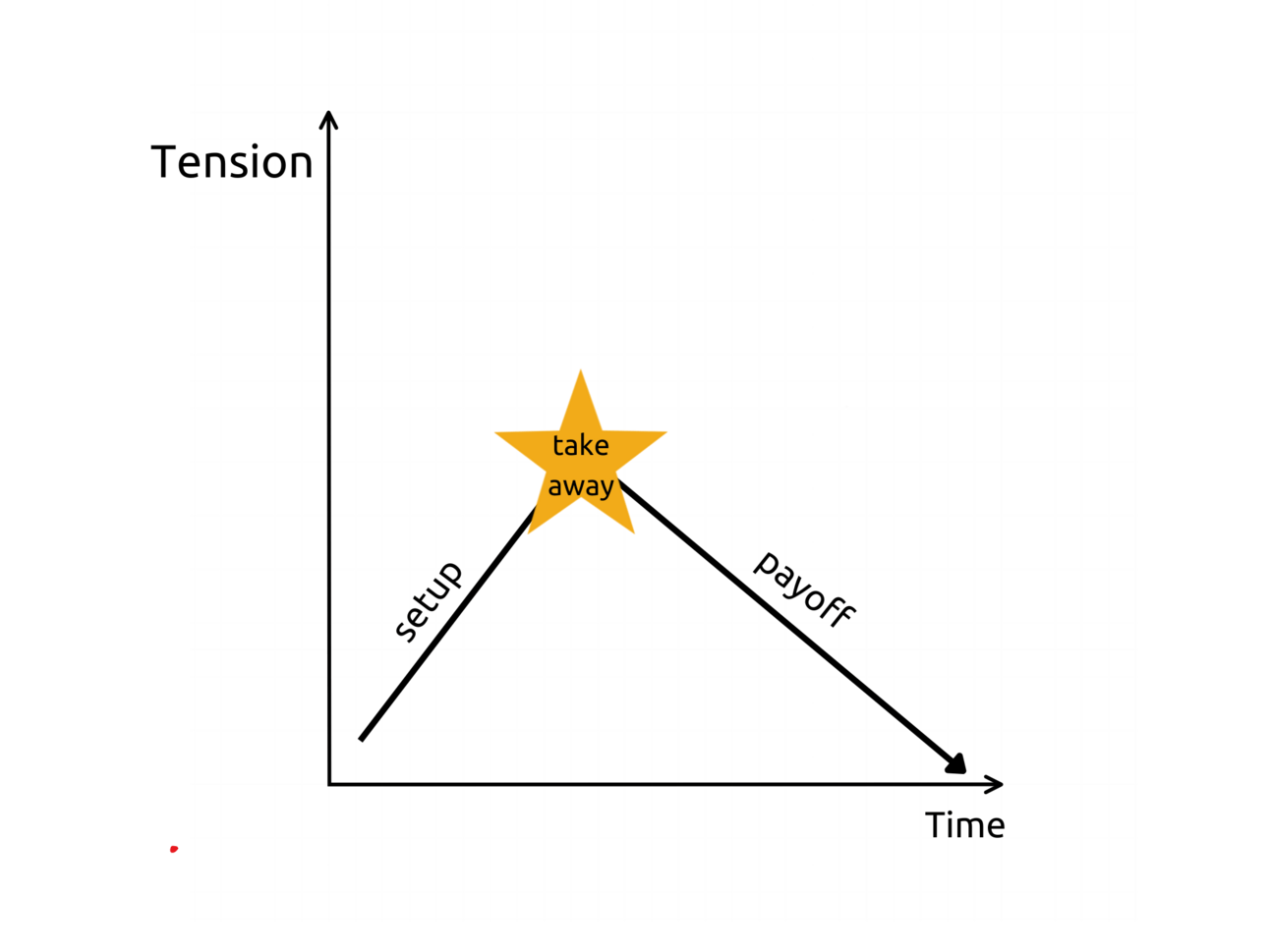
Setup-Takeaway-Payoff
Pro Tip: Use this framework in stakeholder meetings to quickly align everyone on the problem, solution, and expected outcomes.
Practical Applications of Storytelling
Crafting a Product Vision:
Use aspirational, user-centered language to describe the future impact of your product.
Example: “Imagine a world where freelancers never chase payments—it’s all handled seamlessly.”
Presenting a Roadmap:
Frame each roadmap item as a chapter in your product’s journey, linking features to user stories.
Example: “Next quarter, we’ll roll out a new onboarding flow to make the first 30 minutes with our product effortless.”
Engaging Users Through Stories:
Share customer success stories that show the real-world impact of your product.
Example: “Meet Alex, a small business owner who doubled their productivity using our platform.”
Stakeholder Product Reviews
You can also teleport into the future and imagine the headline for the product launch. This generates excitement and takes your audience along with you to the future.
Example: “CONNECT, MATCH, LOVE: New Social Networking App Makes Connections Easy ❤️ “
Tips for Effective Storytelling 💡
Know your audience: Understand who your audience is, what they care about, and what resonates with them.
Keep it simple: Avoid using jargon or complex terminology that might confuse your audience.
Use vivid imagery: Incorporate sensory details to bring your story to life and make it more memorable.
Make it concise: Keep your story brief and to the point, avoiding unnecessary details or tangents.
Practice, practice, practice: Rehearse your story until it feels natural and comfortable, and be prepared to adapt it to different audiences and situations.
Question & Answer 🙋♀️
Q: I don’t see myself as a “natural storyteller.” How do I get started?
A: Start small and practice. Use the Setup-Takeaway-Payoff framework to structure even simple updates or presentations. With time, you’ll develop confidence in your ability to create narratives.
Q: How do I ensure my stories resonate with stakeholders?
A: Tailor your stories to the audience:
For executives: Focus on business impact.
For engineers: Highlight the technical challenges and how they were solved.
For customers: Show how the product fits into their lives and makes things easier.
Take Action ✅
This week, apply one of the storytelling frameworks:
Choose a recent product decision or feature.
Craft a story around it using either the Hero’s Journey or Setup, Takeaway, Payoff framework.
Share your story with a colleague or team and ask for feedback. Or even better, share with me!
If you liked this newsletter, please share it with your friends and colleagues. 👯♀️