- The Product Prism
- Posts
- 💫 Navigating Uncertainty with Confidence
💫 Navigating Uncertainty with Confidence
PM 101: A Practical Guide to Managing Risk and Uncertainty

Gloria Adebayo
November 21, 2024 • Estimated Reading Time: 11 minutes
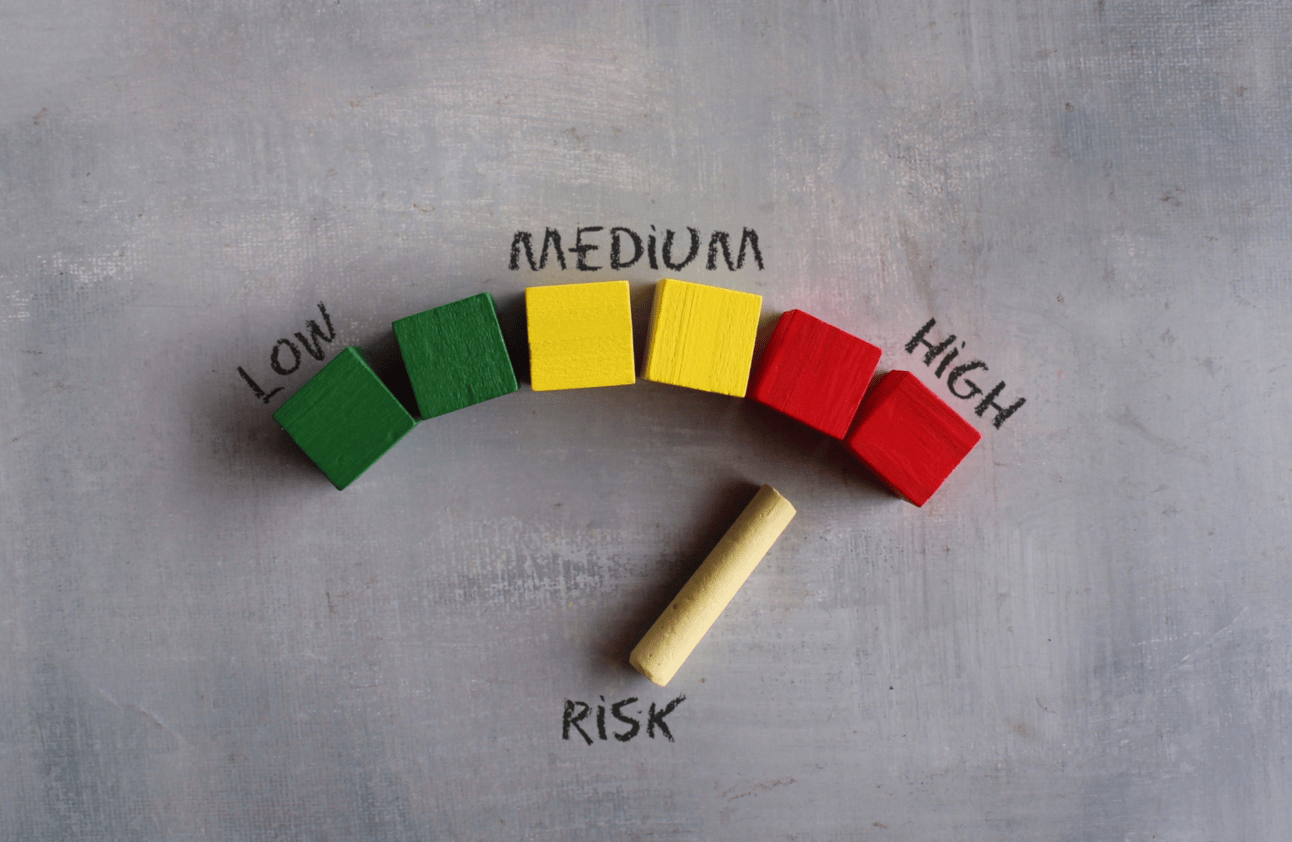
In this issue
Every product manager knows the stakes are high—whether it's launching a new feature or building a product from scratch, risks lurk at every corner. But instead of fearing the unknown, what if you could master it?
In this issue, discover:
The hard truths about product failure rates.
Types of Risk
The common risks in product management and how to identify them.
Tools like the Risk Breakdown Structure (RBS) and SWOT Analysis to manage uncertainty.
A simple, effective process for mitigating risks and ensuring product success.
This week, I am introducing a notebooklm-generated deep dive 🎉 . I hope you enjoy listening to my AI friends. Take a listen below.
Let’s dive in! 🚀
Introduction
Meet Olivia, a talented product manager who works at CompanyX and learned risk management the hard way. CompanyX sought to expand its capabilities across content management systems to serve its diverse customer base and thus invested resources in this venture. The product to be built was a connector, i.e. an application for customers using the specific CMS. [Like building an app in WordPress or Shopify].
Olivia and her team went in head first, not anticipating any major risks. It turned out that the CMS ecosystem was a black box with complicated documentation, very limited and slow support, and an unclear path to success. After 6 months of trying, they realized that what they had struggled to build could not meet the customers' needs. It was an epic fail, an unknown unknown risk scenario that cost the business thousands of dollars. 😤
How could Olivia have anticipated this and prevented an extended waste of resources?
Hard Facts: Why Risk Management Matters 📊
Let’s start with some sobering statistics:
95% of consumer products fail within their first year due to poor product-market fit, lack of differentiation, or operational challenges.
90% of startups fail, with 42% citing “building something no one wants” as the primary reason.
Ignoring risks doesn’t make them disappear—it amplifies their impact. For product managers, mastering risk management isn’t just about preventing failures; it’s about positioning your product for success by anticipating challenges and planning your response.
The Many Faces of Risk 🛑
Not all risks are created equal. Some are obvious and well-understood, while others are hidden or emerge unexpectedly. Here’s a framework to categorize risks based on what you know:
Known Knowns:
These are the risks you’re fully aware of and understand. They’re the easiest to manage because you can plan for them.Example: A delayed API integration affecting your launch timeline.
Tip: Document and address these risks systematically using tools like a Risk Matrix.
Known Unknowns:
These are risks you’re aware of, but their specifics are unclear. They require further investigation to reduce uncertainty.Example: How users will respond to a new feature.
Tip: Use research, testing, or market analysis to gain clarity.
Unknown Knowns:
These risks are known to someone in your organization but are not recognized by you. Often, they arise from gaps in communication or siloed knowledge.Example: A previous technical debt issue that could impact scalability.
Tip: Foster cross-functional collaboration and transparency to surface hidden risks. Arrange a risk analysis workshop.
Unknown Unknowns:
These are the unforeseen risks you didn’t even know to anticipate. They’re often disruptive and require agility to address.Example: A sudden regulatory change that affects your product’s compliance.
Tip: Build flexibility into your plans and maintain a contingency budget for unexpected challenges.
Understanding these categories helps you anticipate and respond to risks more effectively. By recognizing what you know—and don’t know—you can better prepare for the uncertainties of product management.
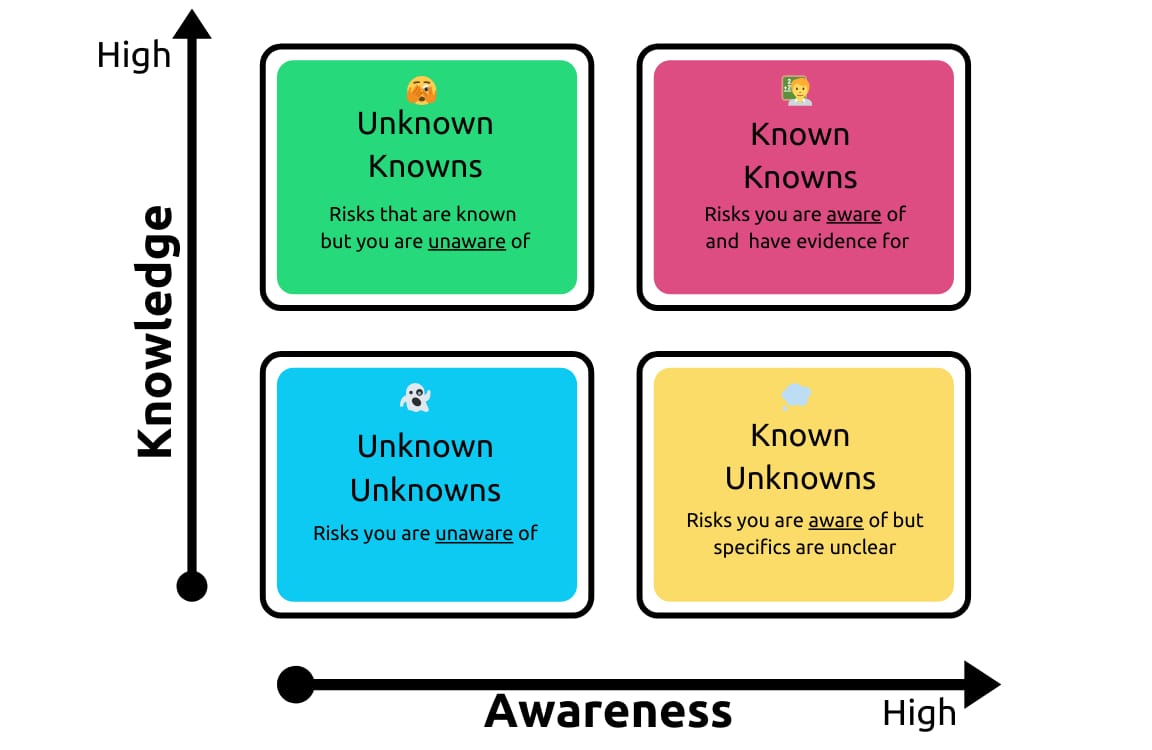
Types of Risk
What Could Go Wrong? Common Risks in Product Management 🆘
Product management is a balancing act of competing priorities, and risks arise at every stage. Here are common risks to look out for:
Building Something No One Wants:
Risk: Misaligned product-market fit due to incomplete user research or flawed assumptions.
Example: Launching a feature that users don’t adopt because it solves the wrong problem.
Technical Hurdles:
Risk: Unexpected delays, scalability issues, dependency bottlenecks, or inadequate knowledge of the area.
Example: An integration with a critical third-party API that’s a black box, lacking adequate documentation. Hot mess.
Marketing and Sales Challenges:
Risk: Ineffective go-to-market strategies or high CAC (Customer Acquisition Cost).
Example: A poorly defined value proposition leads to low conversion rates despite heavy ad spend.
Opportunity Costs:
Risk: Prioritizing low-impact features while competitors capture high-value opportunities.
Example: Spending months refining minor UX improvements instead of addressing a major pain point.
Pro Tip: Keep a risk log during the discovery and planning phases. Reviewing it regularly will help you spot recurring patterns.
Steps in Risk Management: A Four-Stage Framework 🔄
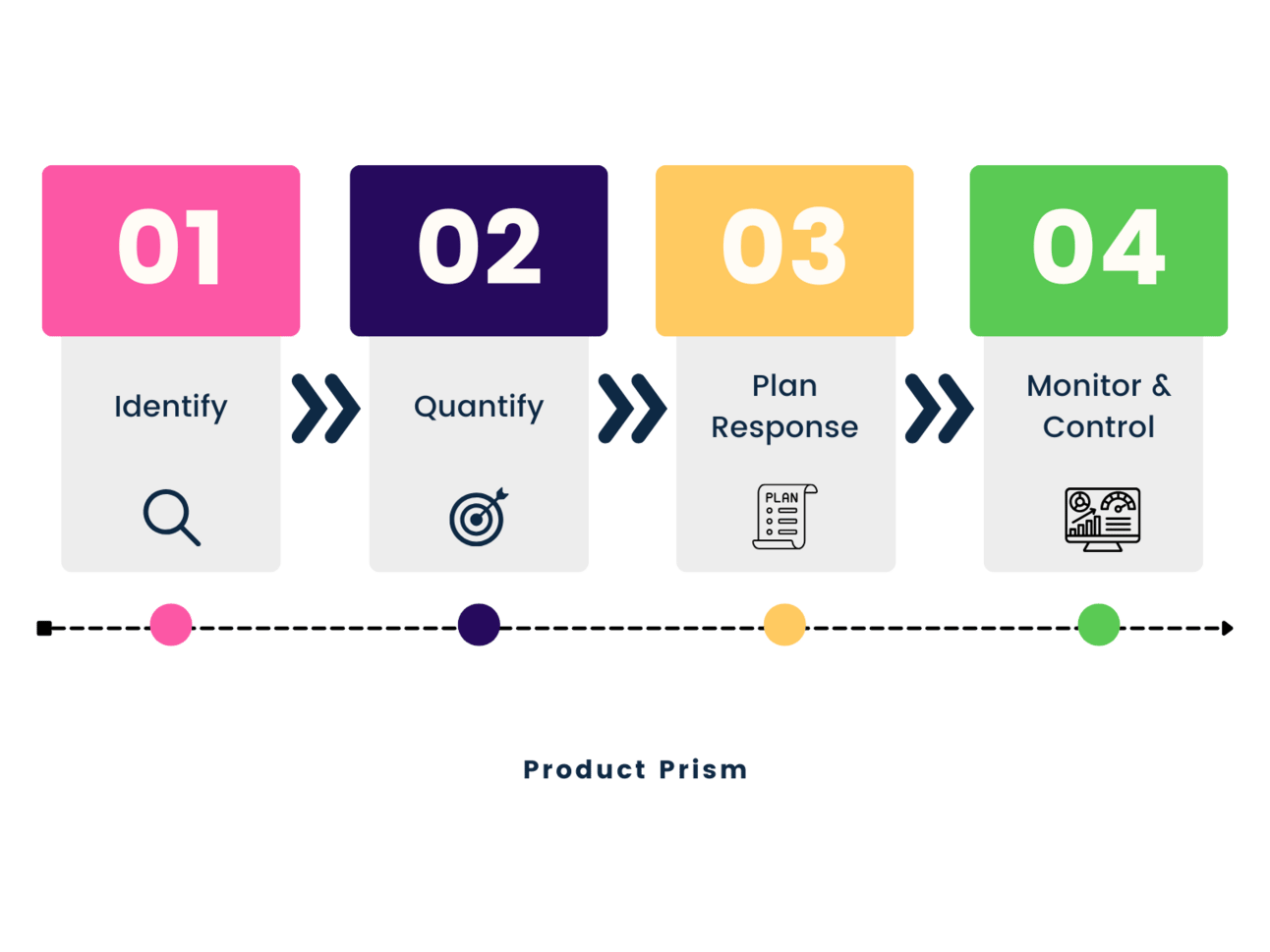
1. Risk Identification:
Identify risks early and often by brainstorming potential internal and external threats.
Internal Risks: Within your control (e.g., resource constraints, roadmap delays).
External Risks: Beyond your control (e.g., market shifts, regulatory changes).
Tool: Use a Risk Breakdown Structure (RBS) to categorize risks into buckets like technical, market, operational, and financial.
2. Risk Quantification:
Assess each risk based on Probability (P) and Impact (I) to prioritize effectively.
Probability (P):
How likely is it that this risk will occur?
Rare, Unlikely, Moderate, Likely, Very Likely
Example: A new integration failing during testing might be ‘Very Likely’ if it's complex or involves new technology.
Impact (I):
If the risk occurs, how severe will the consequences be?
Trivial, Minor, Moderate, Major, Extreme
Example: A major regulatory non-compliance issue could be ‘Major’ if it delays the product launch significantly.
Tool: The Risk Matrix helps visualize where to focus your attention. See the sample matrix in the tools section below.
3. Response Planning:
Develop an action plan for each risk:
Prevent: Proactively reduce the likelihood of occurrence.
Mitigate: Reduce the impact if the risk materializes.
Accept: Acknowledge low-priority risks that don’t warrant intervention.
Pro Tip: Prioritize the top 3 risks to keep your plan manageable and actionable.
4. Risk Monitoring & Control:
Risk management doesn’t stop after planning; it’s an ongoing process. Risks evolve as your product progresses, making regular monitoring and updates essential.
Regularly review risks during sprint reviews or roadmap updates.
Update your risk log as new risks emerge or existing ones evolve.
Regularly reassess risks in light of new data. A low probability risk today might become more likely due to changing circumstances.
Tools for Risk Management 🛠️
Risk Breakdown Structure (RBS):
Purpose:
The RBS is a hierarchical framework that identifies, organises, and categorises risks systematically. By grouping them into logical categories, it helps ensure no potential risks are overlooked.Key Features:
Hierarchical Structure: Risks are broken down into levels of detail (e.g., Technical > Integration > API delays).
Focus on Identification: It’s primarily used in the risk identification phase to create a comprehensive list of potential risks.
Categorization: Group risks into broader areas like Technical, Market, Operational, or Financial.
When to Use:
Early in the process, during the identification phase, to ensure a holistic view of risks.
Example: Risk Breakdown Structure
Category | Subcategory | Example Risks |
|---|---|---|
Technical | Integration | Delayed API readiness |
Scalability | Performance issues under load | |
Market | Competitors | A new disruptive feature from a rival |
Customer Needs | Shifts in user expectations | |
Operational | Staffing | Team shortages during development |
SWOT Analysis:
SWOT Analysis is a strategic planning tool used to identify and evaluate a project, product, or business’s Strengths, Weaknesses, Opportunities, and Threats. It’s a versatile framework that provides a holistic view of internal and external factors impacting success.
Components of SWOT Analysis
Strengths (S): Internal advantages that give your product a competitive edge.
Examples: Unique features, strong team, proprietary technology.
Weaknesses (W): Internal limitations or challenges that could hinder success.
Examples: Limited resources, lack of brand recognition, technical debt.
Opportunities (O): External factors that can be leveraged to gain a competitive advantage.
Examples: Market gaps, emerging technologies, and changing user preferences.
Threats (T): External factors that could negatively impact success.
Examples: Competitors, regulatory changes, economic downturns.
A SWOT analysis, while not specific to any stage, is most applicable and important for new products, i.e. zero to 1.
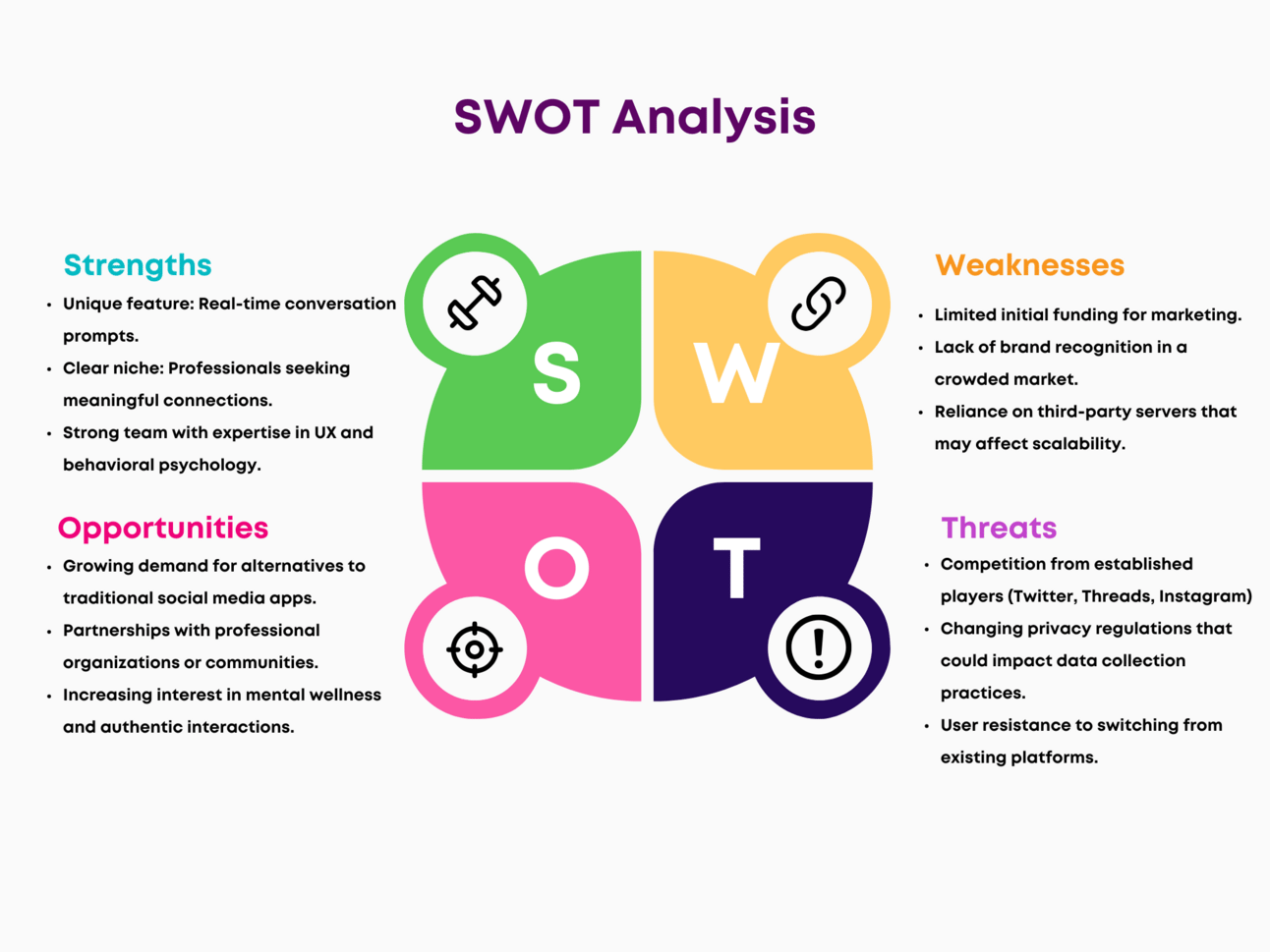
SWOT Analysis for a Social Media App
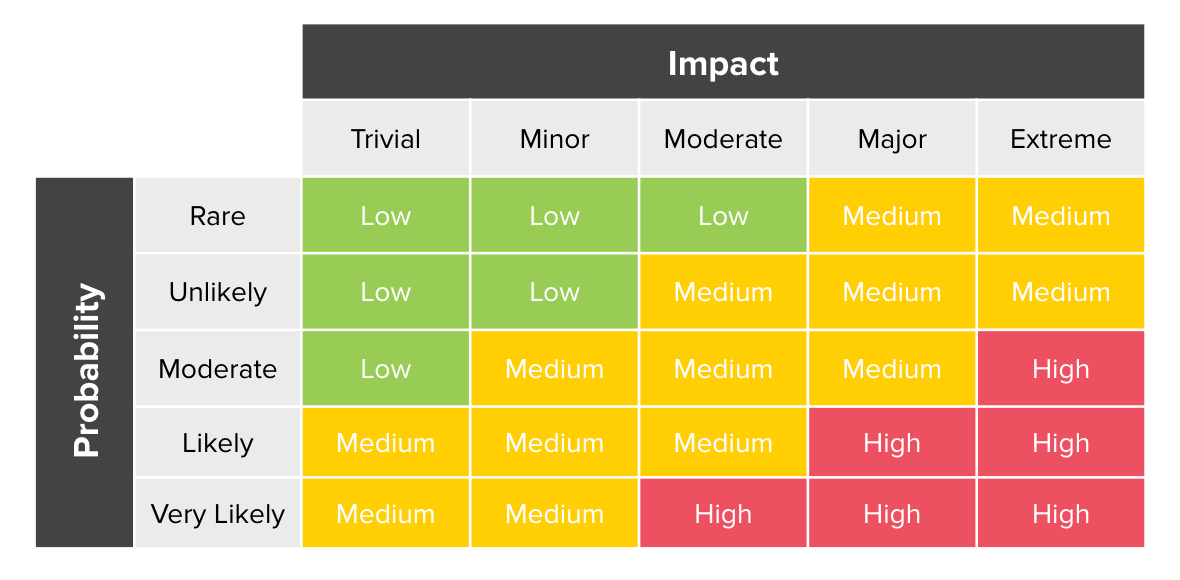
Risk Matrix:
Purpose:
The Risk Matrix is used to evaluate and prioritize risks based on their likelihood (probability) and impact. It helps focus attention on the most critical risks.Key Features:
Visual Tool: Risks are plotted on a grid to show their relative severity.
Focus on Prioritization: Primarily used in the quantification phase to decide which risks need the most attention.
Risk Levels: Risks are classified as Low, Medium, or High based on their position on the matrix.
When to Use:
After identifying risks using an RBS, use the Risk Matrix to prioritize mitigation efforts during the quantification phase.
Example Risk Matrix:
Team Workshops:
Collaborate with cross-functional teams to identify risks and brainstorm responses. This one tool helps with the “Unknown Known” type of risk. Having a cross-functional risk analysis workshop ensures that different risk perspectives are identified and can be adequately managed.
Tools & Tips:
Book more than an hour. Conversations usually go on for a while, and you also need time to collect and identify mitigation strategies.
If you are in a remote team, tools like Miro, FigJam, and Mural effectively foster this collaboration.
Back to Olivia 👩🏫
To answer the question in the Intro section: “How could Olivia have anticipated this and prevented an extended waste of resources?”
Olivia could have anticipated and mitigated this issue by conducting a risk analysis workshop in collaboration with the Engineering team. This session would have likely uncovered the risk early, allowing the team to explore mitigation strategies, such as conducting initial research or technical feasibility assessments.
If the risk proved unavoidable, Olivia could have communicated it transparently to stakeholders, ensuring alignment on the potential constraints posed by the Content Management System. This shared understanding could have led to an informed decision to either halt the project early or proceed with full awareness of the risks.
By addressing the risk proactively, Olivia could have saved the company thousands of dollars in wasted resources and positioned herself as a leader who anticipates challenges and manages them effectively.
Question & Answer 🙋♀️
Q: How do I balance risk management with innovation?
A: Innovation inherently involves risk, but managing it means focusing on calculated risks. Define clear mitigation strategies for your riskiest bets and allocate resources accordingly.
Q: What’s the best way to document risks?
A: Use a Risk Log—a simple document or dashboard that tracks:
Risk description.
Probability and impact scores.
Mitigation plans and owners.
Please send me your questions by hitting reply!
Take Action ✅
This week, try applying the Risk Management Framework:
Identify the top risks for your current product or feature in collaboration with the larger team.
Use a Risk Matrix to prioritize them.
Define one action to mitigate or accept each high-priority risk.
Review your plan with your team and refine it.