- The Product Prism
- Posts
- 🚀 The One Thing That Separates Successful Products from Failures 💡
🚀 The One Thing That Separates Successful Products from Failures 💡
Product Management 101: Customer Discovery and Validation

Gloria Adebayo
September 12, 2024 • Estimated Reading Time: 8 minutes

The greatest job of a product manager is to identify and solve the right problems to create meaningful value for both the user and the business.
In this issue
We focus on research in the context of building a product from the ground up. We'll dive into Customer Discovery and Customer Validation, the dynamic duo of research that helps you ensure you're solving a real problem and not just building a fancy solution looking for a problem to solve.
You'll learn how to:
- Gather insights without losing your mind.
- Ask potential users the right questions (and actually get helpful answers) 💬
- Test your assumptions (because let's face it, we're all a little biased)🤷♂️
- Gain confidence before moving forward with product development (because who doesn't want to avoid costly mistakes?) 💪
So, buckle up and let's dive in!"
Introduction
Welcome to the wild world of product research! You know, that magical place where you try to figure out if your product idea is actually worth building. It's like being a detective, minus the cool hat and trench coat (although, let's be real, who wouldn't want to wear those while doing research?).
But seriously, research is the secret sauce that separates successful products from those that, well, aren't. And here's the thing: research isn't just for the starting line (0 to 1). It's also crucial for the iterative sprints (1 to N), where you're refining, optimizing, and scaling based on customer feedback. Think of it like this: when building from scratch, research helps you find the right problem to solve, and when iterating, research ensures you're solving it in the best way possible.
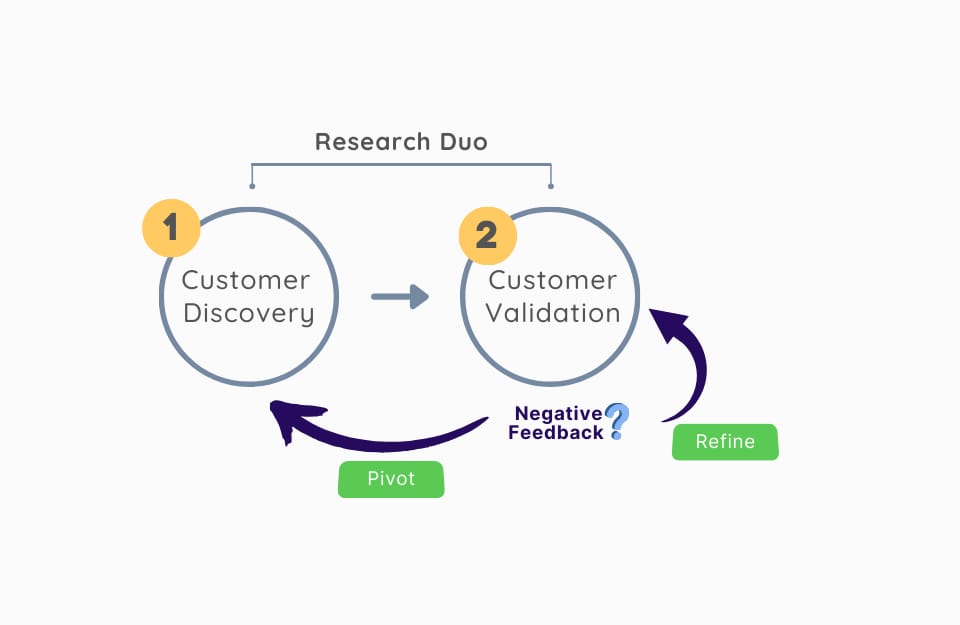
When building from 0 to 1, i.e., from the ground up, Customer Discovery and Validation are essential for success.
So, why conduct Research? (Or How to Avoid Becoming the Next Juicero) 🤦♂️
You know the old adage: "Don't build a solution looking for a problem." But, let's be real, it's easy to get caught up in the excitement of creating something new and shiny. That's why research is crucial – to ensure you're not building a Juicero-esque solution to a non-existent problem.
The Cautionary Tale of Juicero 🍊
Remember Juicero, the $700 Wi-Fi enabled juicer that squeezed juice packets? Yeah, that was a thing. And a costly one. Juicero raised millions, only to realize people didn't need (or want) a high-tech juicer. It's a classic case of building a solution to a non-problem. Don't be like Juicero. Read more about Juicero here
Research to the Rescue
Conducting research helps you:
- Validate your ideas ✔️
- Understand real user needs 🗣️
- Avoid building solutions to non-existent problems 🚫
- Create something people actually want ❤️
By doing research, you'll save time, money, and embarrassment. Trust us; your users (and your investors) will thank you.
Customer Discovery: Uncovering Real Problems 🔍
Imagine embarking on a journey to a new city without a map. You'd want to talk to locals, observe the landscape, and gather clues to understand the city's rhythms and challenges. Customer Discovery is similar – it's a journey to understand the uncharted territory of your customers' needs and pain points. As you explore, you'll gather insights through exploratory research, using both qualitative and quantitative methods. It's like collecting pieces of a puzzle, where each conversation, survey, and observation helps you see the bigger picture.
Key Concepts:
Exploratory Research: In the early stage, research involves gathering qualitative and quantitative data to gain a comprehensive understanding of the customer's needs and pain points.
Quantitative methods: Surveys, Online Polls
Qualitative methods: Interviews, Observations, Focus groups
Understanding Pain Points: Your objective here is to listen and uncover the critical problems your product should address. The more accurately you understand these issues, the better positioned you are to design a valuable solution.
Techniques:
Interviews: Direct conversations with potential customers are invaluable. Ask open-ended questions like:
“What are the biggest challenges you face in [problem area]?”
"What's the hardest thing about [doing this thing]?"
"Why was that hard?"
"Tell me about the last time you encountered that problem?"
"What, if anything, have you done to solve the problem?"
"What don't you love about the solutions you've tried?"
Surveys: Use surveys to gather quantitative data on the issues identified in interviews. These help validate assumptions and confirm trends. e.g. “90% of respondents believe they pay too much for energy.”
Competitive Analysis: Look at existing products to understand how they solve similar problems and what gaps your solution could fill.
When you are done, you will be very clear about the core problems your users face and can identify patterns.
Customer Validation: The Reality Check ✅
You've got a brilliant idea, but is it actually brilliant? Or is it just a solution looking for a problem? Customer Validation is like a reality check, where you test your assumptions in the real world before you invest too much time and resources. Think of it like a chef testing a new recipe. You've mixed and matched ingredients, but will the dish actually taste good? You need to serve it to real people and gather feedback.
Key Concepts:
Hypothesis Testing: During the 0 to 1 phase, every product idea is built on assumptions. In Customer Validation, you test these assumptions in real-world scenarios by presenting prototypes or MVPs to your audience and gathering feedback.
Prototype Feedback: Whether it’s a clickable wireframe or a more developed MVP, getting tangible products in front of potential users allows you to gauge how well your solution fits their needs.
Build > Measure > Learn: A feedback loop and key component of the Lean Startup methodology commonly used in the customer validation phase to navigate the process of developing and refining a product or service.
Early Adopter Feedback: Early adopters are critical during the validation process. These users are willing to try new solutions and provide honest feedback that can shape the final product.
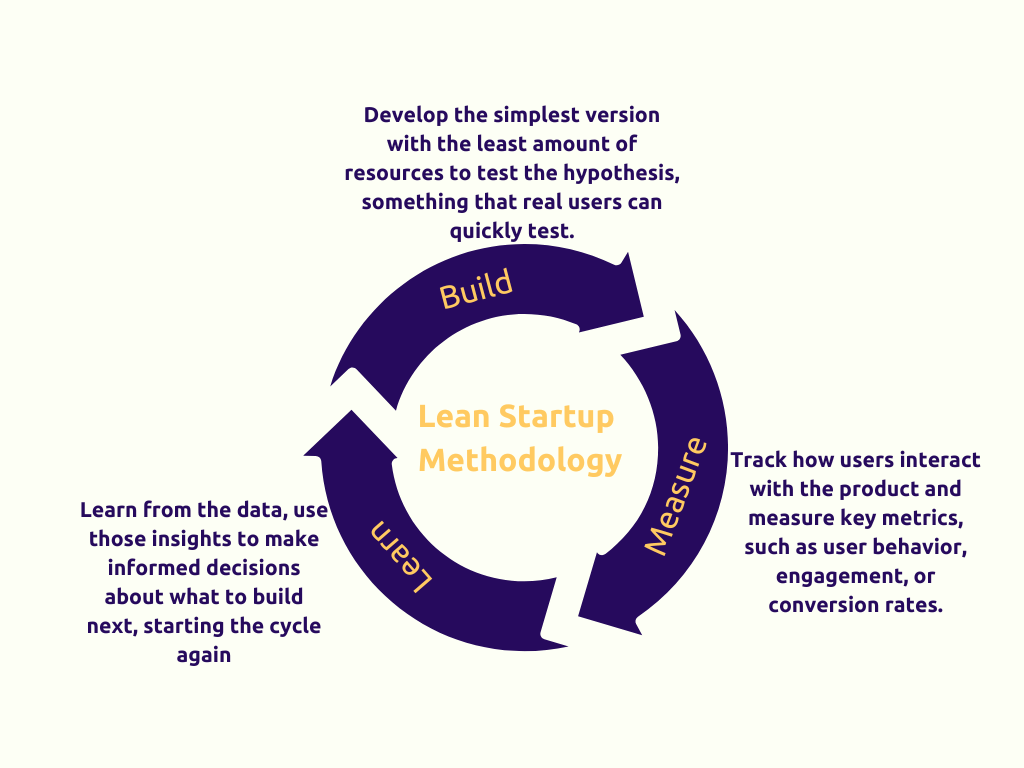
Build-Measure-Learn
Techniques:
Prototyping: Create a simple version of your product (e.g., wireframes or clickable demos) and test it with your target audience. Collect feedback on usability, perceived value, and key features.
Landing Pages: Build a landing page to test interest in your product. Include clear calls to action like “Sign up for early access” or “Pre-order now” to gauge user engagement.
Crowdfunding Campaigns: Launching a campaign on platforms like Kickstarter or Indiegogo is another way to validate demand. If users are willing to commit financially, you know you’re on the right track.
What if?
What if the results of customer validation are negative?
Negative results are just as valuable as positive ones! If your idea isn’t resonating, use the feedback to pivot OR refine your solution. It’s better to adjust early before investing heavily in development.
Secondary Research: Completing the Picture 🧩
Complete your research picture by combining primary research (customer discovery and validation) with secondary research for a deeper understanding of your customers and market using tools such as PESTEL Analysis and Porter’s 5 Forces.
Think of it like being a detective, searching for clues in:
- Government reports (yawn, but useful!)
- Industry associations (where the cool kids hang out)
- Google (where the magic happens)
With secondary research, you'll find the coveted TAM, SAM, and SOM. It's like finding the Golden Ticket to understanding your market!
Book Recommendation 📚
In this section, I recommend a book. Most book recommendations will have a summary you can read or listen to in 20 minutes or less in my Blinkist Space here.
Today’s Recommendation
"Lean Startup" by Eric Reis
This book is foundational for anyone looking to understand how to approach Customer Discovery and Validation. It introduces the Build-Measure-Learn loop, a key concept in refining product ideas based on real feedback.
Take Action 👨🔧
Identify 10 people in your target audience to interview. Gather the insights and look out for a recurring pattern.
Develop a simple prototype or landing page for your product and gather feedback.
Stay product-tastic, and see you in the next issue! 📚
Tolu