- The Product Prism
- Posts
- 🎯📈 Setting Product Goals that Drive Success
🎯📈 Setting Product Goals that Drive Success
A Guide with proven strategies for product goal setting.

Gloria Adebayo
January 09, 2025 • Estimated Reading Time: 10 minutes
In this issue
Happy New Year, Fam! In my home country, they say, “Whenever you wake up, that is your morning”. Yup, at Product Prism, the year just started; today is our morning😀.
As we kick off a fresh year, I thought I would start on a lighter note and do some groundwork on which we can build together. The new year is also the perfect time to reflect on past wins and set our sights on new horizons.
In this issue, we're diving deep into the art of setting practical product goals—the kind that not only drives product success but also fuels your growth as a PM. We'll explore what a product goal truly is, introduce the robust SMART framework, and give you the tools to craft goals that will set you up for a winning year. Get ready to level up your goal-setting game today!
In this issue, discover:
What a product goal truly is, plus what it isn’t.
What makes a goal effective.
Types of Product Goals.
Tools for crafting compelling product goals!
What to do when your goals are handed down to you
Common Pitfalls with goal setting
Output vs Outcome
Examples of Product goals
A template worksheet to get you started with goal setting.
Let’s dive in! 🚀
Introduction
Imagine a product team firing on all cylinders—everyone aligned, focused, and driven by a shared purpose. What are some of the key ingredients in this recipe for success? While there's no magic bullet, clearly defined, powerful product goals are a crucial element without which the team risks spinning wheels, prone to constantly shifting priorities and ultimately expending energy without making any real impact.
Setting impactful goals starts with understanding what a real product goal is—and, importantly, what it isn't.
What are Product Goals (and what they aren't)?
A product goal is a specific, measurable outcome you aim to achieve for your product within a defined timeframe. Think of it as the destination you want to reach. It’s the ‘what’ you want to accomplish. It's not a task, a feature, or a metric itself, but rather the desired result that those things contribute to.
Let's clarify further:
Product Goals vs. Objectives and Key Results (OKRs): OKRs are a goal-setting framework typically used at the organizational level. Think of them as the company's big ambitions. Product goals often contribute to broader OKRs, acting as stepping stones. For example, a company's OKR might be to "Increase market share by 20%," a related product goal could be to "Increase new user acquisition by 10% in Q1."
Product Goals vs. Metrics/KPIs: Metrics are the ‘how’ you measure progress towards your goals. They are the data points that tell you whether you're on track. A goal might be "Improve customer satisfaction," and a KPI to measure that could be "Customer Satisfaction Score (CSAT)."
Product Goals vs. Tasks/Features: Tasks are the actions you take to achieve your goals—the ‘how’ you get there. Features are the specific functionalities you build within your product. A goal might be "Improving user onboarding," and a task could be "Redesign the welcome flow."
Types of Product Goals
Categorizing goals helps provide context and ensures a balanced approach. Below are some types of goals you should consider for your product.
Growth Goals: These focus on expanding the user base, increasing market share, boosting revenue, or driving other key growth metrics.
Examples: Increase new user sign-ups by 20%, achieve a 15% market share in a new segment, and grow monthly recurring revenue by 10%.
Engagement Goals: These aim to improve user activity, retention, satisfaction, or loyalty.
Examples: Increase daily/monthly active users, improve customer satisfaction score (CSAT), reduce churn rate, and increase feature adoption.
Innovation Goals: These focus on launching new products or features, entering new markets, or adopting new technologies.
Examples: Launch a new mobile app, introduce a new premium feature, expand into a new geographic market, and integrate with a new platform.
Operational Goals: These aim to improve internal processes, efficiency, or cost-effectiveness. While less directly customer-facing, they can significantly impact product success.
Examples: Reduce customer support tickets by 10%, decrease bug resolution time, and streamline the product development process.
How? The SMART Framework: Your Goal-Setting Superpower
The SMART framework is a tried-and-true method for creating effective goals. It ensures your goals are:
Specific: Clearly defined and focused. Avoid vague language like "improve" or "increase" without explicit attributes. Be precise about what you want to achieve.
Measurable: Quantifiable so you can track progress. Use metrics to define success. Use specific metrics like "conversion rate," "customer satisfaction score," or "feature adoption rate."
Achievable: Realistic and attainable within the given timeframe and resources. Don't set yourself up for failure with overly ambitious goals. Consider your team's capacity and available resources.
Relevant: Aligned with your product strategy and overall business objectives. Ensure your goals contribute to the bigger picture and move the needle for your product and the company.
Time-bound: With a clear deadline. This creates a sense of urgency and helps you stay focused. Define a clear start and end date.
Example of SMART Product Goals
SMART: "Increase daily active users by 15% by the end of Q1 2025."
Not SMART: "Increase user engagement."
SMART: "Increase the completion rate of the onboarding flow from 60% to 80% by the end of February 2025."
Not SMART: "Improve the onboarding experience."
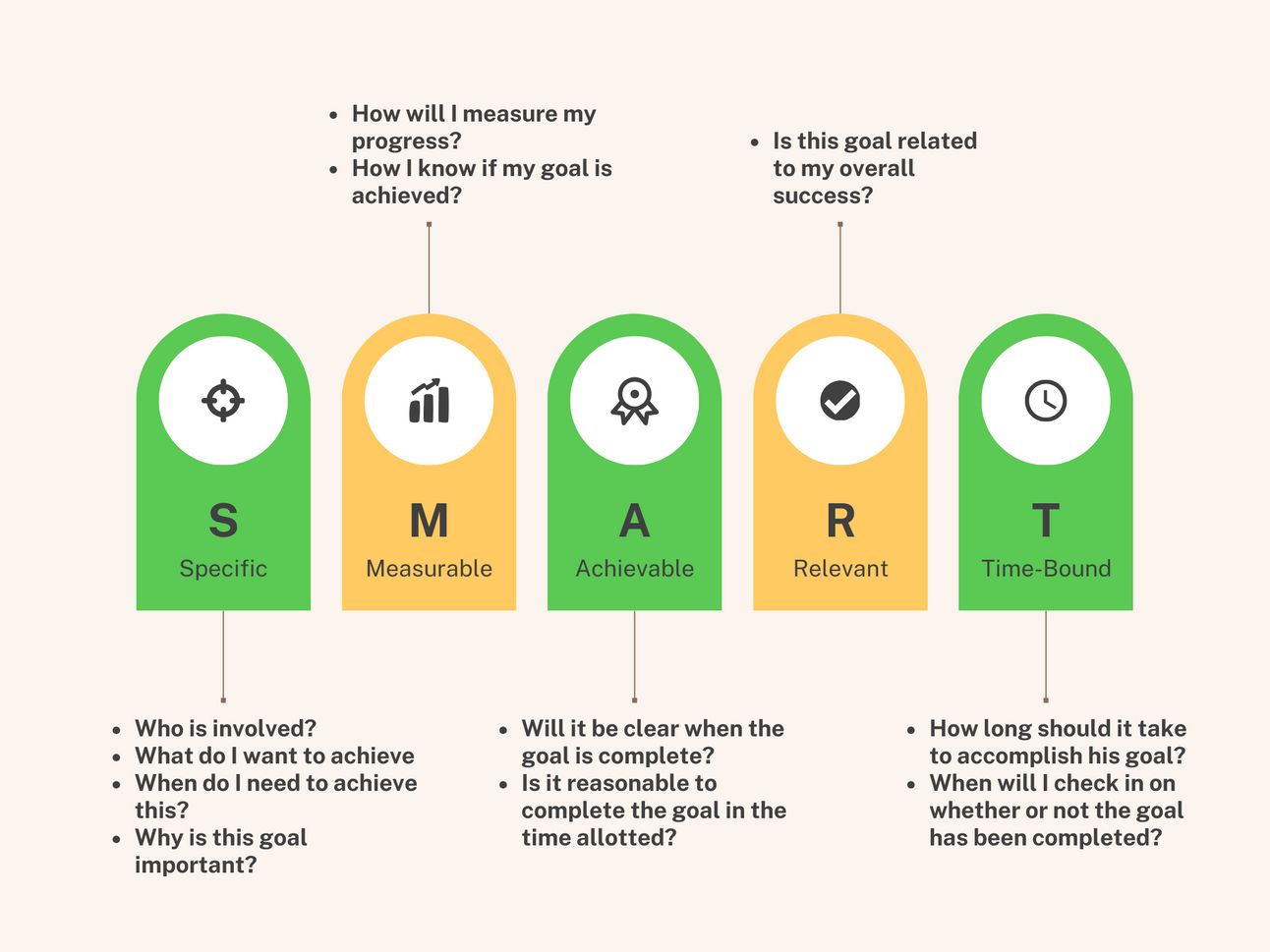
SMART Framework
“But my Goals are handed to me” - Addressing the Reality of Top-Down Goals
Now, let's address a common scenario: Often, product goals are handed down from leadership. This is perfectly normal. However, even when goals are top-down, understanding the SMART framework is essential for a PM. Why? Because:
You need to interpret and operationalize those high-level goals: A leadership team might say, "Increase revenue by 20%." It's your job as a PM to translate that into concrete product goals. For example, you might define product goals like "Increase conversion rates by 10%" or "Launch two new premium features by the end of Q2."
You need to validate the feasibility of those goals. If a top-down goal is unrealistic given your resources or market conditions, you need to articulate why and propose more achievable targets. The SMART framework provides a structured way to present your case.
You need to track and report on progress: Even if you didn't set the initial goal, you're responsible for tracking progress and reporting to stakeholders. SMART goals make tracking and reporting much easier.
You can influence future goal-setting: By demonstrating your ability to manage and achieve goals effectively, you build credibility and gain more influence in future goal-setting discussions.
In short, even when goals are handed down, the SMART framework empowers you to be a more effective and strategic product manager.
Common Pitfalls in Product Goal Setting 🪤
Setting Too Many Goals: Trying to achieve too much at once can dilute focus and lead to overwhelm. It's better to focus on a few key priorities.
Setting Conflicting Goals: Goals should be aligned and mutually supportive between teams. Conflicting goals can create confusion and hinder progress.
Not Involving the Team: Goal setting should be a collaborative process. Involving the team ensures buy-in and shared ownership.
Not Tracking Progress Regularly: Goals are useless if you don't track progress and make adjustments as needed. Regular monitoring is essential.
Setting Vague or Unmeasurable Goals: It is impossible to track progress or determine whether the goal has been achieved. The SMART framework helps avoid this.
Focusing Solely on Output, Not Outcome: Focusing on shipping features (output) rather than the impact those features have on users (outcome) is a common trap.
For example, launching a new feature (output) doesn't guarantee increased user engagement (outcome). Focus on the change you want to see in user behaviour, business metrics, or market conditions. A better goal shifts focus to the outcome, for example, "Increase the completion rate of the onboarding flow from 60% to 80%.”
Outputs vs. Outcomes: The Key Difference
Earlier in my career, I often struggled with the difference between output and outcomes. I’d think I got it and then give an example and find I was wrong. Well, you don’t have to make that mistake. Let’s break it down.
Outputs: These are the tangible deliverables or activities that your team produces. They are ‘what’ you create. Outputs are easily measurable in terms of quantity or completion.
Outcomes: These are the impacts or results of those outputs. They are the ‘why’ you created those outputs. Outcomes focus on the change you want to see in user behaviour, business metrics, or market conditions.
Feature | Output | Outcome |
|---|---|---|
Focus | Activities, deliverables, features | Impact, results, changes |
Measurable by | Quantity, completion, delivery date | Change in user behaviour, metrics |
Answers | What did we create? | What impact did it have? |
Example (Onboarding) | Launched a new onboarding flow | Increased onboarding completion rate by 20%. |
Tip💡: When communicating with stakeholders, ask yourself in every scenario. “Should I be speaking output, outcomes or both?” For example, in Q1, we launched a new onboarding flow expected to increase our onboarding completion rate by 20%.
Question & Answer 🙋♀️
Q: So, how many goals is ideal?
A: There's no magic number, but a good starting point is to focus on 2-3 key product goals per quarter. This allows for focus and effective resource allocation. It's better to achieve a few critical goals than to spread resources too thin and achieve nothing significant.
Tool Spotlight 🛠️
Download a template 🏁
We have created a worksheet to support creating your product goals; you can download the template, which also includes a good example here. This template can be recreated easily in Notion or Confluence.
Take Action ✅
Download the Goal Setting Worksheet (above - you can copy and paste this into a spreadsheet) and start drafting at least three SMART product goals for the first quarter of 2025. Share one of your goals (or even a challenge you're facing in setting them) with me on BlueSky or Linkedin – let's inspire and support each other!
If you liked this newsletter, please share it with your friends and colleagues. 👯♀️
Help others discover Product Prism!
The Product Prism now has a referral system! 🎉
Refer three (3) friends, and get a Product Management Case Study template + example.
Refer ten (10) friends, and you'll receive a one-off 30-minute session with me to discuss anything related to product management or development. It’s an ‘Ask-me-anything’ session.
Happy Goal-Setting,
Tolu 💜